
If your county is moving toward selling your house for unpaid property taxes, you have more choices before the sale than after it. You can pay the balance, ask the tax office about a payment plan, or sell the house yourself and pay the back taxes out of the proceeds. We buy houses as-is in Houston, San Antonio, Dallas and other U.S. markets. We make a cash offer, and you pick the closing date. All offers are subject to inspection and transaction requirements.
This guide explains what a tax sale is, how it differs from a mortgage foreclosure, what to do first, and how a sale of the house handles the taxes owed.
TL;DR
- A tax sale is the county collecting unpaid property tax. It is a different process from a mortgage foreclosure, and the tax lien usually comes first.
- Call the tax collector now. Get the exact amount owed, the deadline and any payment plan in writing. Many plans are only open before the sale.
- Selling the house is a recognized way to clear back taxes: they are paid from the sale proceeds, or the buyer gets a credit for them.
- Rules, deadlines and redemption periods change by state and county. Check yours with the tax office or a legal aid office.
- We make a cash offer, buy as-is, and charge no commissions or listing fees. Offers are subject to inspection and transaction requirements.
Table of Contents
- What a back tax sale actually is
- Tax sale versus mortgage foreclosure
- What to do in the first week
- Paying it off, redeeming, or selling
- How a back-tax sale works with a cash buyer
- Texas homeowners
- Spotting real help and avoiding scams
- Ready to see a number?
- FAQ
- Sources
What a back tax sale actually is
When property taxes go unpaid, the county puts a lien on the property. A lien is a legal claim that has to be cleared before the title can pass cleanly to anyone. If the debt stays unpaid, the county can sell the debt or the property at a public auction. Illinois Legal Aid Online explains that the county’s tax lien takes priority over other liens, even ones recorded first, and that a tax buyer may become the new owner.
There are two common versions, and which one applies depends on your state:
- Tax deed sale. The taxing authority sells the home outright and the buyer gets title, sometimes after a redemption period.
- Tax lien certificate sale. The authority sells the lien. The buyer then forecloses or follows another procedure to get the deed.
Nolo’s legal encyclopedia lays out both, and notes that property tax liens almost always rank ahead of mortgage liens. That means a mortgage can be wiped out if the home is lost through a tax sale.
The Housing Solutions Lab describes the usual outcomes: the owner pays the back taxes and keeps the property, a lien sale hands the right to foreclose to a purchaser, or the lien moves to a municipality or land bank. Your local government decides which track you are on, which is why the first call matters so much.
Tax sale versus mortgage foreclosure
People search for both at once because the letters look alike. They are different problems with different clocks.
| Tax sale | Mortgage foreclosure | |
|---|---|---|
| Who starts it | The county or taxing authority | Your mortgage lender |
| What is owed | Unpaid property taxes, interest and costs | Missed loan payments and the loan balance |
| Lien priority | Usually first, ahead of the mortgage | Behind the tax lien |
| Typical risk | Loss of the property or the right to it to a tax buyer | Court-ordered or contract-based sale to repay the lender |
Illinois Legal Aid Online describes the difference this way: a tax sale is the county selling unpaid tax debt at auction, while a lender may seek a court order to sell the property to recover its money.
The two connect. If you have a mortgage and stop paying taxes, Nolo says your loan servicer will probably pay the overdue amount and bill you for it. If you cannot repay the servicer, you could default on the loan. A tax sale can also wipe out the mortgage, so servicers act fast. Falling behind on taxes can therefore turn into a mortgage problem. If you are already behind on the mortgage too, our foreclosure timeline shows how long each stage usually takes.
What to do in the first week
The goal of the first week is facts. You need the real number, the real deadline and the real status.
- Call the tax collector or treasurer. The AARP Foundation’s Property Tax-Aide guidance suggests contacting the office that handles property taxes to confirm the amount owed, whether assistance exists and what the deadlines are.
- Ask about repayment plans and exemptions. The same guidance notes that payment plans in many places are only available before a tax sale, and some areas offer relief for older homeowners. Ask early.
- Get everything in writing. Ask for the payoff figure, the last day to pay and the sale date. Ask whether the figure includes interest and fees, and whether it changes by date.
- Find free legal help. After a tax sale notice, AARP suggests contacting your nearest legal aid office or your local bar association’s lawyer referral service.
- Read your mail. Notices have legal deadlines attached. Do not set them aside.
Some places run their own hotlines. Philadelphia Legal Assistance, for example, sets up repayment plans and runs a hotline for delinquent taxes and sheriff-sale notices. Your local legal aid office can tell you what exists where you live.
Why the exact date matters
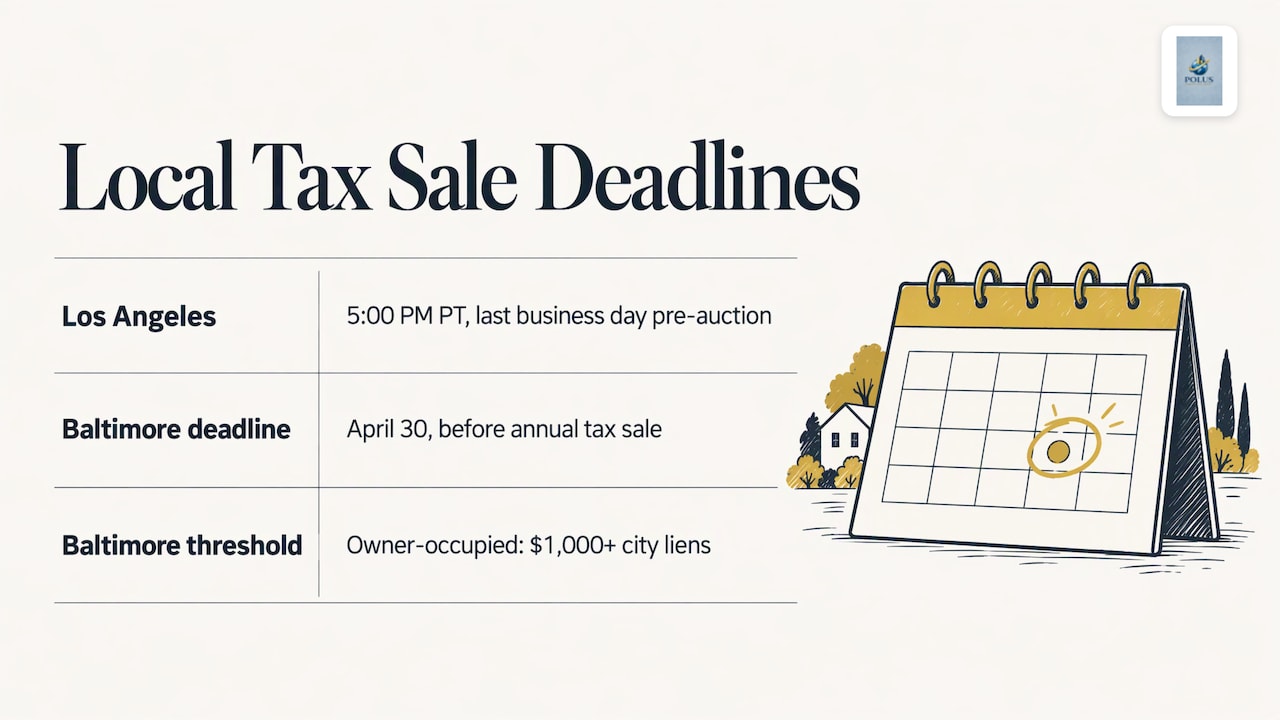
Deadlines are specific and unforgiving. Los Angeles County’s consumer office says the deadline to pay to save a property from sale is 5:00 PM Pacific Time on the last business day before the auction. In Baltimore, the last day to pay overdue city bills to avoid the annual tax sale is April 30, and owner-occupied homes become eligible at $1,000 or more in combined city liens.
Those are examples, not your rules. Your county’s calendar, thresholds and notice rules are the ones that count. Some places also let you remove a property from the sale list with a partial payment. The Maryland Department of Assessments and Taxation notes that some counties pull a property if a partial payment drops the bill below a set threshold, while most do not offer payment plans to avoid the sale. Ask your county whether a threshold like that exists.
Paying it off, redeeming, or selling
Here are your realistic paths, in the order we would look at them.
Pay the balance or set up a plan
If you can pay the full balance before the sale, the matter is closed. If you cannot, a plan or exemption may fit. In Washington, D.C., Legal Aid DC lists paying the taxes, bringing the prior-year balance below $2,500, or getting a forbearance as ways off the sale list. Homeowners 65 or older with adjusted gross income under $50,000 may qualify for a senior tax deferral. Programs like these vary widely and many are only open before the sale date.
If you have other debts competing for the same money, it can help to see where interest is costing you most. This guide on how to negotiate lower interest rates on debts can free cash for the tax bill.
Redeem after a sale, if your state allows it
Some states give the former owner a redemption period: a window to repay the tax debt plus interest and keep the property. Others transfer the deed right away. The Housing Solutions Lab notes both patterns exist. Costs can climb after the sale. In D.C., Legal Aid DC explains that redeeming after a foreclosure suit is filed also means paying the purchaser’s attorney’s fees and expenses. Maryland law, Tax-Property Article § 14-817.1, says redeeming more than four months after the sale may require reimbursing the certificate holder up to $250 for a title search and up to $500 in attorney’s fees.
Redeeming after the sale is the harder road. The cheaper moment to act is before it.
Sell the house
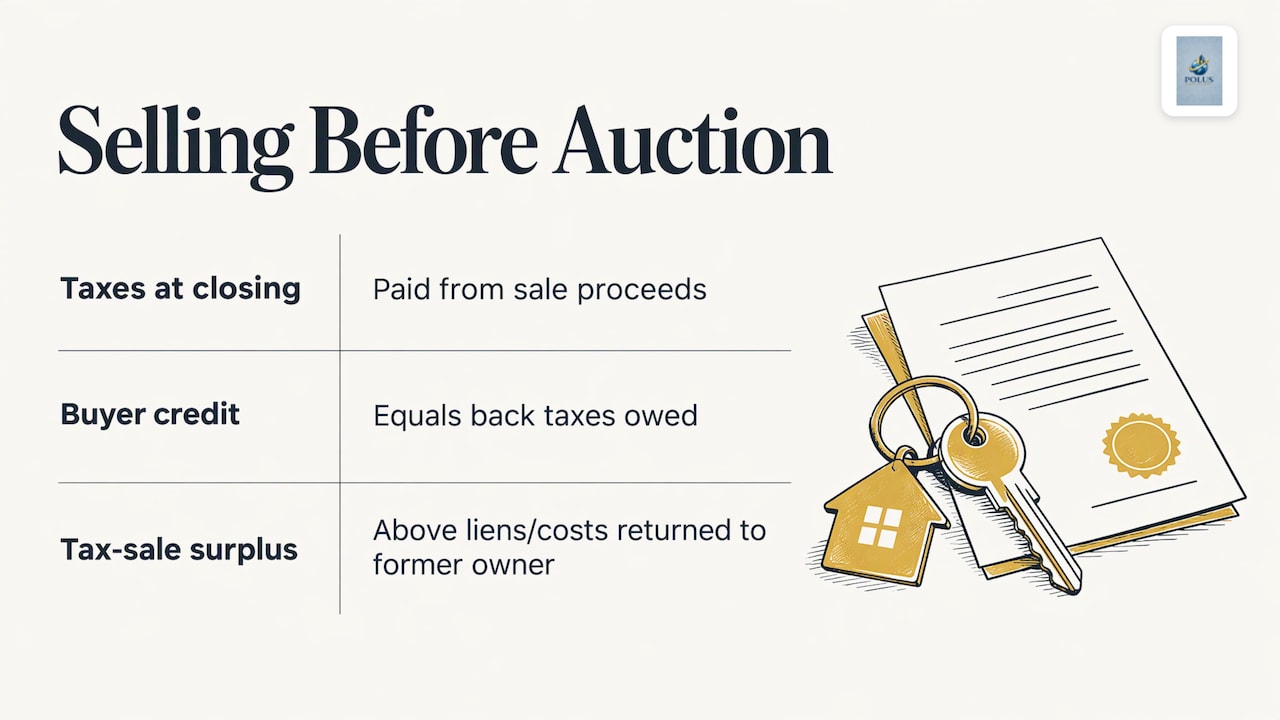
Selling before the auction is a mainstream route. The Los Angeles County consumer guide says the most common way to sell a house with property taxes owed is to pay the back taxes from the sale proceeds or give the buyer a credit equal to the amount owed. The taxes get settled at closing, rather than by you out of pocket.
There is a bonus for owners who have equity. The Housing Solutions Lab reports that after the U.S. Supreme Court’s Tyler v. Hennepin County decision, surplus proceeds above the liens and authorized costs from a tax foreclosure sale must be returned to the former owner. Even so, an auction usually starts from the taxes owed plus interest and costs, so a direct sale is where you control the terms and the timing.
How a back-tax sale works with a cash buyer
A traditional listing needs repairs, photos, showings and weeks on the market. If a tax deadline is near, that is a lot of moving parts. Here is how a direct sale works with us:
- You request a free offer review online or call (281) 771-1395. Tell us the address and what you know about the tax balance.
- We make a cash offer. The offer is subject to inspection and transaction requirements.
- You choose the closing date. We can close in as little as 10 days, though the timeline depends on the transaction. No closing is guaranteed.
- Taxes and liens are handled at closing. As described above, back taxes are paid from the proceeds. We handle the legal and paperwork side directly with you in complex situations.
- No repairs, no commissions, no listing fees. We buy in any condition.
A worked example
Suppose a house in Houston would sell for a round number, and the owner owes a few years of back taxes plus a mortgage. Whatever the final price, the closing statement lists each payoff: the county taxes, the mortgage, and any other liens, with the remainder going to the seller. If the payoffs exceed the price, the seller needs to know that before choosing a path. Our net proceeds calculator compares a cash offer with listing the house so you can see what ends up in your pocket. Our guide to selling a house with a mortgage shows how payoffs and net proceeds work. If you owe more than the house is worth, read about underwater home sales.
If you are a landlord or inherited the house
Back taxes often pile up on houses nobody lives in: a rental that has become a burden, a vacant property, or an inherited home where the heirs are still sorting things out. The same rule applies. The lien stays with the property, and interest keeps adding to it. Selling as-is lets you pay it off at closing without fixing up the house first. Landlords can read our guide to selling rental property for the tax and tenant side.
Texas homeowners
If your house is in Houston, San Antonio or Dallas, you can start with the pages we wrote for those markets: Houston and San Antonio. If a mortgage default is part of your situation, read selling before foreclosure in Texas. Texas deadlines and redemption rules are set by the state and your county, so confirm your own dates with the county tax office or a legal aid office before you decide.
Spotting real help and avoiding scams
Anyone in financial trouble gets calls and letters. Stay safe:
- Be wary of anyone who asks for a large fee up front before doing any work.
- Be wary of anyone who asks you to sign over the deed, or to sign papers you have not read.
- Be wary of anyone who tells you to stop talking to your lender or tax office.
- Use free resources first: your tax collector, legal aid and your local bar association’s referral service.
- Read every document before you sign, and ask for a copy.
With us, there are no agent commissions or listing fees, and you can request a free offer review with no obligation. If you want a lawyer to look over the paperwork, that is a smart step for any sale.
What we see from the seller’s side
A tax notice feels like a verdict, but it is a bill with a date on it. The sellers we talk with are usually not short on options. They are short on time and clear numbers. We built our process around one idea: give you a straight cash offer fast, buy the house as it stands, and let you choose the closing date.
We have bought over 200 homes since 2015, in Houston, San Antonio, Dallas and other U.S. markets. Taxes, liens and paperwork are part of many of those deals, and we deal with sellers directly. A tax sale is the county’s process, and the county’s deadlines are real. A direct sale lets you handle the debt on your schedule, with no repairs, showings or commissions, subject to inspection and transaction requirements.
Ammanuel
Ready to see a number?
If you are behind on property taxes and want to know what your house would bring as-is, we will review it for free. We make a cash offer, we buy in Houston, San Antonio, Dallas and other U.S. markets, and you choose the closing date. Offers are subject to inspection and transaction requirements.

Request your free offer on our cash home offer page or call (281) 771-1395.
FAQ
Can I sell a house that has back taxes owed?
Yes. The most common approach is to pay the back taxes from the sale proceeds or give the buyer a credit for the amount owed, according to Los Angeles County’s consumer office. The payoff shows on the closing statement, so you know what is owed and what you receive.
What is the difference between a tax sale and a foreclosure?
A tax sale is the county collecting unpaid property taxes by selling the debt or the property. A mortgage foreclosure is your lender recovering an unpaid loan. The tax lien usually ranks ahead of the mortgage, so the two can affect each other.
How long do I have to get my property back after a tax sale?
It depends on your state. Some states give a redemption period and others transfer the deed immediately. Maryland, for example, lets owners redeem until a court forecloses the right, and purchasers may foreclose as early as six months after the sale. Ask your tax collector for the exact deadline in writing.
Do I get money back if the property sells for more than I owe?
After the Supreme Court’s Tyler v. Hennepin County decision, surplus proceeds above the liens and authorized costs from a tax foreclosure sale must be returned to the former owner. Procedures differ by state, so ask your county how to claim any surplus.
Sources
- Unpaid property taxes (FAQ), Illinois Legal Aid Online
- What Happens If You Don’t Pay Property Taxes? Nolo
- Foreclosure and disposition of tax-delinquent properties, Housing Solutions Lab
- Property Tax-Aide: Tax Sales, Appeals & Legal Questions, AARP Foundation
- Real Estate Taxes, Philadelphia Legal Assistance
- Overdue Property Taxes, LA County Consumer & Business Affairs
- Tax Sale Coordination and Prevention Services, Baltimore City
- Frequently Asked Questions about Tax Sale, Maryland Department of Assessments and Taxation
- Property Tax Sale FAQs, Legal Aid DC
- Maryland Tax-Property Article, Section 14-817.1
- 5 ways to negotiate lower interest rates on existing debts, ExpressPlanner